November Musings; Certificates of Authenticity? Why and how?
How are we already saying goodbye to November and hello to December?!! I think it’s partly because it’s been so mild and autumn has lasted so long that it doesn’t feel like we should be approaching winter and (dare I say?)….Christmas. I’ve been spending this month doing lots of ‘school things’; parents evenings, trips, SENDCO meetings, the builders are also back and the garage conversion is almost a proper living room (yay!) and I cannot wait to put a Christmas tree up in there! I’ve been working away on the cheeky and colourful bird portraits and preparing for the WERFA Christmas market which I am really looking forward to! There’s also lots of behind the scenes work going on at the mo which has meant I have been a bit rubbish at posting on social media recently; I do find thats the first thing to go when I’m busy!
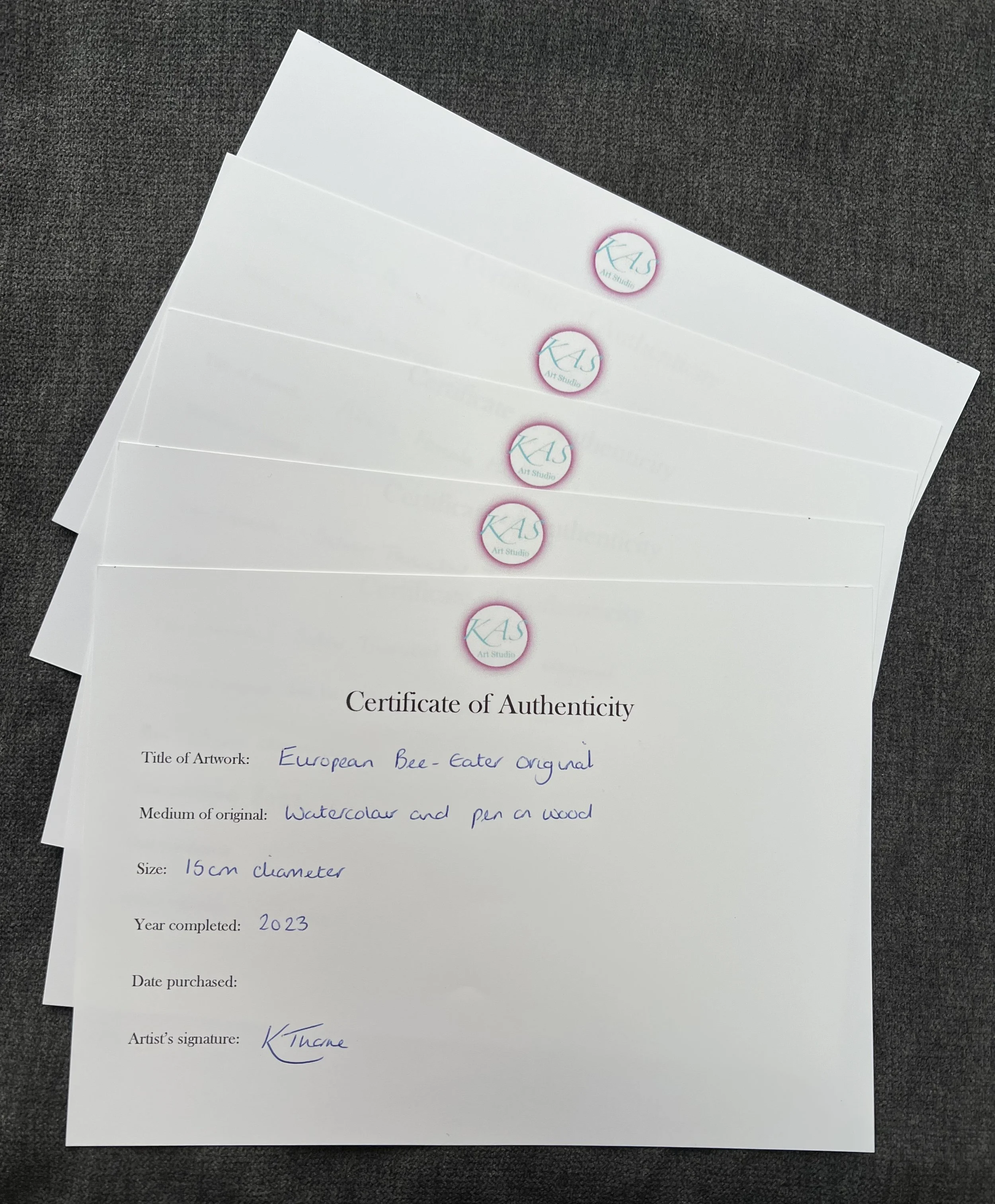
One of my jobs this month was to finally sort out my Certificates of Authentication (COA)! This has been something that has been on my list for a while, something I knew I needed to review but I wasn’t sure what I wanted. When I first started selling my work I had small A5 certificates printed. These were very simple and inexpensive as not only was I learning but I was just starting out and needed to keep my costs down.
I then started to print my own on quality paper to try to further reduce my costs and initially they were fine; not amazing, but fine. When I started to create larger and more expensive pieces the home printed certificates (mainly due to my very basic printer) started to feel unprofessional and didn’t ‘fit’ with the prices I was asking for my originals. I wanted my clients to feel like they were receiving something special when they chose my work, I wanted to be proud of it and I felt the certificates didn’t reflect that. So, I started to look into the reasons behind COA’s, what should be included and what I wanted mine to portray and I thought I would share this with you guys! (This months blog is more wordy and less imagey so prepare yourself;)
So, what is a Certificate or Authentication?
Firstly, in order to decide what sort of COA I wanted I thought it was important to understand its purpose, what it does and whether it’s worth the extra admin, because there is already enough of that, right?!
Most products especially high-end items have some way to authenticate them, whether it’s a signature logo, pattern, registration or serial number. This not only means the item can be traced but its legitimacy can be proven and consequently its quality. A COA acts as a proof of authorship which has become increasingly important when creatives are not protected as much as they should be by copyright; we’ve all heard of a certain cheap company who constantly steals art work from artists instagram pages and sells fuzzy, low quality copies!
Part of being a professional artist is running a business and a COA for a piece of art, whether its sells or not, documents and proves it was created by the artiist! Although each piece should have the artist’s signature, this can be hidden in framing or mounting, and collectors and galleries will use COA as part of their records and for insurance purposes. Basically it is expected. On the other side, if you are buying a piece of art and potentially spending a large amount of money then you should expect some form of ‘proof’.
And WHY do you need one?
This one is simple in that the COA confirms that a piece of art was created by the artist! However it also determines its current and future value especially if an artist’s work becomes sought after and their reputation as an artist grows. So in someways it is future proofing current work. As well as this a COA can also act as a receipt and record of sale for both anrtist and the buyer; another form of verification!
Any collectors or gallery will expect every piece of art work they purchase or try to sell to have a COA. You could argue an invoice can also serve as proof of the origin of the piece, however a COA is still the preferred and professional way to verify an artwork.
What do you need to include on a COA?
There are two ways to go when introducing COA’s; buying a template is an easy, instant option, or creating your own document. Either way there are certain points of information to include which will make your COA valid:
Artist Name
Title of Work
Year of Completion
Dimensions
Medium (this includes prints of the original artwork) surface and any other relevant information on the materials or processes used.
As well as this basic information (which is enough, especially if you are just starting out) you could also include:
Photo of Artwork as a way to identify and further authenticate a work of art. This is especially useful if is separated from its COA certificate.
Statement of Authenticity. A brief explanation stating the authenticity of the work and relevant copyrights.
Any Additional and Relevant Information. For example the subject or location of the artwork and advice on caring for the artwork.
Finally, the top tips…..
Complete the COA as you complete an original piece of art or receive prints. This is good business practice and it means you are not playing catch up especially if you get a rush of sales!
Spend time and effort on your COA so that it reflects your brand identity and business aesthetics.
Find a printing company that produces quality COAs on thick substantial paper and is reliable. Think about the extras to make your COA special and reflect your brand.
Consider including images of your art work, paper embosser, gold seal, QR codes… choose what you think reflects you and your work!
However you decide to authenticate your work, make sure you are happy with it and it doesn’t impact your ‘creative time’ too much.
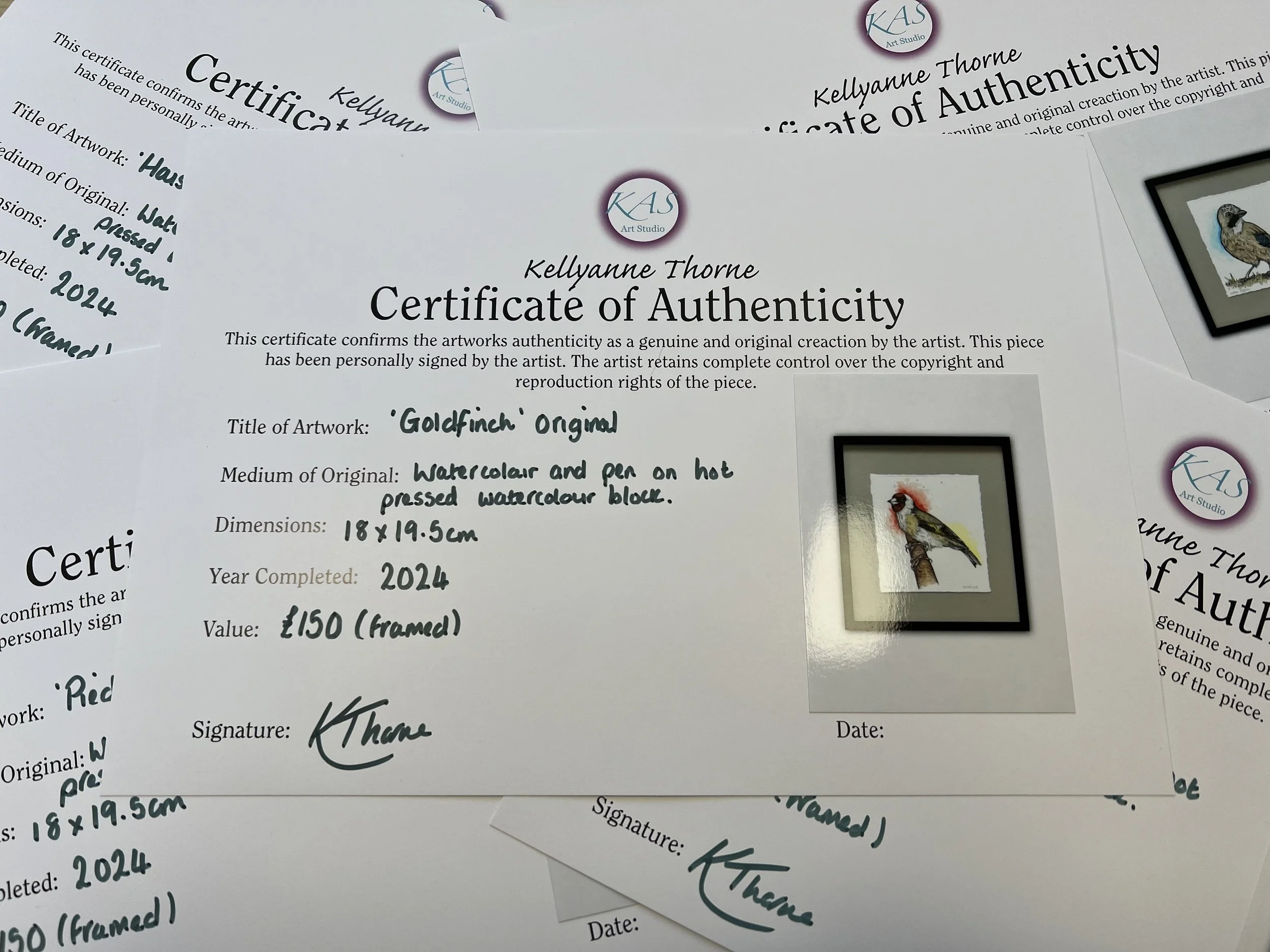
I opted for COA’s printed by a company which I then completed and added a photograph of the piece of art in a protective envelop. I wanted to keep it personal so I decided to fill in each section. These aren’t too time consuming but are professional and reflect my brand. Do that research and find the best fit for your purposes and time!
See you in the end of December, crazy to think Christmas will be over, we’ll be coming to the end of the year and about to begin 2026!!! Eeeeekkkkk!